

Newsletter – Open Science Week 2025
The ‘Open Science Week 2025’ newsletter launches on 14th of October! Here you’ll find all the information about events, resources and the latest news.
During the session, the speakers will present the information needed to make an INFORMED CHOICE of a journal for academic publication. Participants will learn about tools for searching for journals, criteria for assessing their quality and reliability, ways to avoid ‘predatory journals’, and the rules for using open access publishing programmes available to staff, undergraduates and postgraduates at the Medical University of Silesia.
WEBINAR RECORDING in Polish (YouTube, 1 godz. 2 min, 23 sek.)
The webinar will consist of two parts:
Part I
“How do I find a journal for my article?”
Lecturer: Marek Halkiewicz, MA – Department of Bibliography and Bibliometrics
Subject matter:
- selection criteria (subject matter, prestige, visibility, editorial process),
- search engines for academic journals (Master Journal List, Elsevier Journal Finder, Springer Journal Finder),
- bibliometric indicators (Impact Factor, quartiles, Ministry of Science and Higher Education ranking) – how to check and interpret them,
- predatory journals – characteristics,
- verification of journals in the “Journal Citation Reports” and “Web of Science”,
- a search engine for journals covered by open access publishing schemes (developed by Splendor, available on the ŚUM network and via proxy).
Part II
“Open access publishing schemes”:
Presenter: Krzysztof Gościniak, MA – Repository and Open Science Promotion Department
Subject matter:
- the Ministry of Science and Higher Education’s guidelines on Open Access (OA),
- the NCN’s policy on open access to publications,
- open access publishing schemes under the WBN licence (2025),
- programy publikowania otwartego w ramach umów partnerskich ŚUM,
- depositing open research data in the PPM ŚUM repository.
Dates and registration:
Contact: kgosciniak@sum.edu.pl
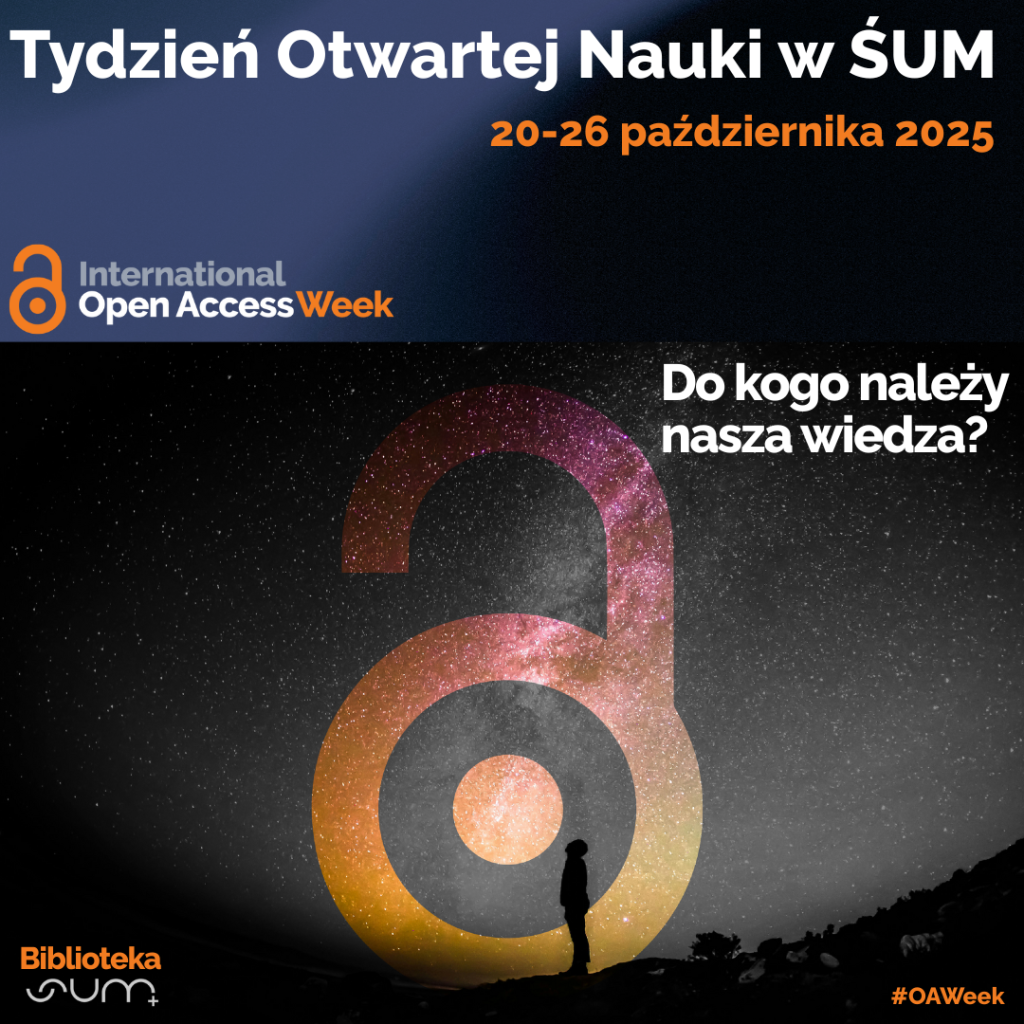
Z okazji Międzynarodowego Tygodnia Otwartej Nauki 2025 zapraszamy studentki/studentów i doktorantki/doktorantów Śląskiego Uniwersytetu Medycznego do udziału w quizie online „Do kogo należy nasza wiedza?”.
Quiz promuje ideę Otwartego Dostępu (Open Access) – swobodnego i bezpłatnego udostępniania wyników badań naukowych. Sprawdź swoją wiedzę o otwartej nauce i wygraj jedną z 12 nagród książkowych!
Jak wziąć udział?
- Zaloguj się na platformie Elearning SUM
- Dołącz do kursu „Do kogo należy nasza wiedza?” przygotowanego w ramach Tygodnia Otwartego Dostępu 2025.
- Wybierz quiz przypisany do swojego Wydziału.
- Odpowiedz na wylosowany zestaw 12 pytań z przygotowanego banku zagadnień.
Szanse są równe – studentki/studenci z każdego wydziału mogą zdobyć nagrody!
Quiz dostępny jest online po zalogowanie na platformie Elearning ŚUM
Hasło dostępu do quizu po zalogowaniu znajduje się w regulaminie (§ 5. Zasady uczestnictwa w konkursie).
Konkurs trwa od 22 października 2025 r. (godz. 10:00) do 24 października 2025 r. (godz. 23:59).
Nie zwlekaj – sprawdź, co wiesz o otwartej nauce i przekonaj się, do kogo naprawdę należy wiedza!
The decision to publish work in open access means…
Greater visibility for publications
OA enables you to reach a wider audience and a larger readership – free of charge and without barriers. Unlike the print version, a digital copy can be accessed by multiple users at the same time. Publishing via OA involves…
INCREASE IN CITATIONS
As a result, your Hirsch index increases. By making your publication available in digital form, you not only make it easier for other researchers who wish to cite it and use a reference manager (e.g. Zotero, Mendeley), but you also reduce the risk of errors in citations to your work (e.g. typos in your surname). In doing so, you are joining positive new trends in academia by focusing on…
THE DEVELOPMENT OF SCIENTIFIC COMMUNICATION
Thanks to OA, it is easier to network with other researchers, share knowledge and develop joint projects, as well as enrich research topics with different perspectives. Researchers interested in OA can look forward to…
NEW FUNDING OPPORTUNITIES
Interdisciplinary Centre for Mathematical and Computational Modelling (ICM) supports Open Access academic publications through open publishing schemes run in collaboration with publishers. Examples include schemes Springer and Elsevier – global leaders in academic publishing, who are increasingly making it possible to publish under the OA model. Thanks to ICM’s involvement, Polish researchers can publish their work under the open access model without incurring any costs associated with APC (Article Processing Charges), which makes research findings more accessible to a wider audience. It is worth bearing in mind that publishing in OA enables…
PRESERVATION OF COPYRIGHT
which means that the author is free to dispose of their work – to distribute it, receive remuneration for its use, and make it publicly available. In the traditional model of publishing in commercial academic journals, authors are often required to transfer their economic copyright to the publisher or grant them an exclusive licence. This model significantly restricts the author’s ability to make their work available independently, for example in repositories or on private websites. By comparison, institutional repositories typically use non-exclusive licences or licences Creative Commons. A non-exclusive licence allows the author to grant further licences to other parties and to publish their work in various places without having to obtain the repository’s consent. This enables authors to freely share their work: in institutional repositories, on their own websites, and on academic or social media platforms. In the case of Creative Commons licences, the terms of access are clearly defined — for example, the CC BY licence requires only attribution, leaving full freedom for the further use of the work.
On 23 October 2015, the Ministry of Science and Higher Education brought into force a document entitled ‘Directions for the development of open access to publications and research results in Poland’, setting out the national open access policy. One of the key recommendations is for universities and research institutes to develop and implement their own policies in this area. These should clarify the rules concerning, amongst other things, the publication of research results, the sharing of open research data, and the deposit of research output in institutional repositories. In 2018, the Medical University of Silesia in Katowice, on the initiative of the MUO Library, adopted the University’s Open Access Policy. The document, approved Uchwałą Nr 127/2018 The resolution of the Senate of the Medical University of Silesia (ŚUM) of 24 October 2018 refers to the implementation of the Open Access Policy within the Polish Medical Platform at ŚUM. In accordance with the adopted guidelines, researchers at the Medical University of Silesia should strive to ensure open access to their publications, doctoral theses and research data by consenting to the deposit of electronic versions of these materials in the institutional repository PPM ŚUM.
Polish initiatives
The Interdisciplinary Centre for Mathematical and Computational Modelling (ICM) at the University of Warsaw runs The Open Science Platform), and also offers several nation, and also offers several nationwide online services related to Open Science.wide online services related to Open Science.
- Science of Library (Library of Science) – an OA platform featuring articles from Polish journals and academic books. It has been in operation since 2014, with a new version launched in 2022. Publications are available free of charge in PDF, EPUB, MOBI and XML formats.
- CeON Repository – an institutional open-access repository for Polish researchers.
- CeON Agregation – a platform that aggregates data from 21 open access repositories, providing access to over 370,000 documents.
- RepOD (Open Data Repository) – a general-purpose repository for research data (tables, photographs, audiovisual materials).
- MX-RDR (Macromolecular Xtallography Raw Data Repository /Raw Data Repository for Macromolecular Crystallography) – a repository of raw data from macromolecular crystallography.
- RDS (Social Data Repository) – a digital repository of social data.
It is worth mentioning the website Open science, which was created for anyone interested in open research and education. It offers an accessible introduction to open science, up-to-date information on best practices, tools and events, and a knowledge base on open models of scientific communication.
The website is edited by the Open Science Platform team. The following organisations have provided honorary patronage: Ministry of Science and Higher Education, Polish Academy of Sciences and Conference of Rectors of Polish Academic Institutions.
European initiatives
- Plan S i cOAlition S It is an international alliance of agencies and foundations that fund scientific research. The most significant initiative of cOAlition S is Plan S, which aims to promote open access to scientific publications.
In accordance with the provisions of Plan S, all publications resulting from research funded by cOAlition S members under calls for proposals announced on or after 1 January 2021 should be published in open-access journals or on open-access platforms, or made openly available in a repository.
- OpenAIRE is a free, pro-social initiative that develops policies, infrastructure and services to support Open Science in Europe and worldwide. It is responsible for services European Open Science Cloud (EOSC).
- International Open Access Week an excellent opportunity to combine the global trend towards open knowledge sharing with progress in political, social and economic change. International Open Access Week has been organised since 2008 by SPARC (Scholarly Publishing and Academic Resources Coalition) and its partners.
ŚUM Medical Platform (PPM ŚUM) has been developing since 2017 as a repository and portal for the management of knowledge and scientific potential. It provides access to publications, research data, doctoral theses, information on grants, and experts in the field of medical and related sciences. Currently, the Repository contains:
- 11 175 articles,
- 1,297 PhDs,
- 37 open research datasets.
The platform is free to use, with no need to create an account, and the materials uploaded can be downloaded and used in accordance with the applicable licence. To date, there have been 11 999 downloads of materials (articles, doctoral theses, research data), and the page was visited exactly 1 947 199 times. PPM has been in operation since the second half of 2020.
Have you finished writing your article and are looking for a suitable journal? Do you want to publish in open access but have some doubts?
The ŚUM Library team provides practical information and direct access to experts who can assist you throughout the publishing process.
- Open access publishing programmes
- Otwarte dane badawcze (Open Research Data)
- Information for authors
- Information about OA
- Repozytorium uczelniane – Polska Platforma Medyczna ŚUM
Repository and Open Science Promotion Department – Contact regarding the ŚUM Repository, open access publishing schemes and open research data
Bibliography and Bibliometrics Department – Contact us regarding citation analysis, bibliometric analysis and the Medical University of Silesia Publications Bibliography
We encourage you to publish in open access and to contact the Medical University of Silesia Library if you have any questions or require assistance in this regard.
The ŚUM Library Team
The event is not organised by the Medical University of Silesia, but may be of interest to those involved in open science.
The University of Warsaw’s Interdisciplinary Centre for Mathematical and Computational Modelling invites you to a webinar on research data management and data repositories.
Terminy: Monday, 20 October 2025, 11:00–12:30
If you have any questions, please do not hesitate to contact our experts on open access, open publishing schemes, open research data and bibliometrics by phone or email.
Throughout the week (20–24 October 2025), between 10:00 and 14:00, the following will be available:
- Marek Halkiewicz, MA – Bibliography and Bibliometrics Department,
tel. 32 208 35 66, e-mail: mhalkiewicz@sum.edu.pl; - Krzysztof Gościniak, MA – Repository and Open Science Promotion Department,
tel. 32 208 36 33, e-mail: kgosciniak@sum.edu.pl